


Please Leave Us A Message
Privacy statement: Your privacy is very important to Us. Our company promises not to disclose your personal information to any external company with out your explicit permission.

Zeson — Xinxiang Zeson Copper Product Co., Ltd. — presses seamless branch fittings and publishes wall and forming-thinning data per size step, so the numbers below can be checked against a die and a mill certificate rather than a catalogue.
Because the governing quantity is not the wall, it is the wall divided by the diameter. The thin-wall form of the hoop-stress equation gives the allowable pressure directly:
P = 2 · S · t / (D − t), where S is the allowable stress of the copper, t the wall, D the outside diameter.
At 1/4 inch (6.35 mm × 0.76 mm), D/t is 8.4. At 1-1/8 inch (28.58 mm × 1.27 mm), D/t is 22.5. The wall is 67% thicker, but the diameter is 350% larger — so the allowable falls to roughly a third. That is why minimum wall thickness for R410A refrigerant copper fitting cannot be stated as a single number: it is a pair, size plus wall, or nothing.
| Size | Standard ACR wall | Allowable, annealed (S = 41 MPa) | Allowable, 1/2H (S = 62 MPa) | Verdict at 4.15 MPa (R410A) |
| 1/4" (6.35) | 0.76 mm | 11.2 MPa | 16.9 MPa | Annealed fine, large margin |
| 3/8" (9.52) | 0.81 mm | 7.6 MPa | 11.5 MPa | Annealed fine |
| 1/2" (12.70) | 0.81 mm | 5.6 MPa | 8.5 MPa | Annealed fine, 35% margin |
| 5/8" (15.88) | 0.89 mm | 4.9 MPa | 7.4 MPa | Annealed passes as tube, marginal as tee |
| 3/4" (19.05) | 1.07 mm | 4.9 MPa | 7.4 MPa | 1/2H from here — OEM standard line |
| 7/8" (22.23) | 1.14 mm | 4.4 MPa | 6.7 MPa | 1/2H, tube-level pass only |
| 1-1/8" (28.58) | 1.27 mm | 3.8 MPa | 5.8 MPa | 1/2H required |
| 1-3/8" (34.93) | 1.40 mm | 3.4 MPa | 5.2 MPa | 1/2H required |
| 1-5/8" (41.28) | 1.52 mm | 3.1 MPa | 4.7 MPa | 1/2H, thin margin |
| 2-1/8" (53.98) | 1.78 mm | 2.8 MPa | 4.2 MPa | Heavier wall needed at fitting level |
Two numbers need stating plainly, because they decide whether the table is read correctly. S is a design allowable, not a burst value. Copper burst pressure runs roughly three to four times these figures, which is the margin a sample approval test is checking. And the table is calculated for refrigerant temperatures, not for steam or hot water: above about 120 °C the allowable stress of annealed copper falls faster than the table implies, which is why heating-side fittings are specified on a different basis.
✅ Bottom line: Pressure capacity is set by D/t, not by wall alone — so a wall number without its size and temper is not a specification, it is a guess.
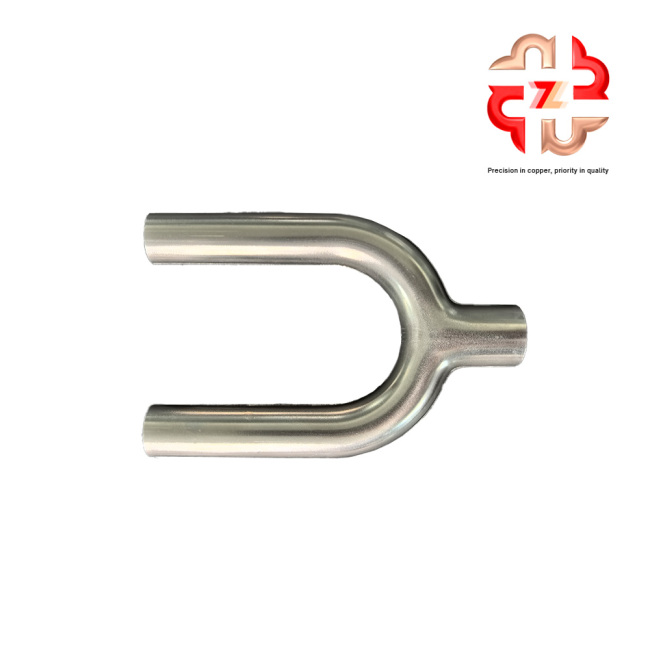
At the branch crotch. A tube has uniform wall along its length; a tee does not. Forming the branch draws material out of the crotch, and 10–15% wall thinning there is normal production behaviour, not a defect — the same order of thinning that a deep-drawn Irregular-shaped Tee shows when the branch angle or centre distance forces a longer draw. This is the point where the copper tee wall thickness vs tube size pressure rating chart stops describing the part you are buying and starts describing the material it came from. The crotch is also where the two stress fields meet, so it is simultaneously the thinnest section and the most concentrated one. The allowable has to be computed on the thinned wall, not the nominal.
The arithmetic is unforgiving at the sizes where it matters. A 7/8 inch annealed body: tube-level 4.43 MPa, which passes 4.15 MPa with 7% to spare — and 3.90 MPa once 12% crotch thinning is applied, which fails. The tube is compliant and the tee made from it is not, on the same mill certificate. This is exactly why OEM installation manuals push to half-hard from 3/4 inch upward: above that size, annealed tube still passes on paper while the Three-way Connection pressed from it does not.
Verification, then, has to be aimed at the right place. Three checks cover it, and they are the ones worth writing into a purchase order if you need to know how to verify copper fitting wall thickness before payment:
The same rule travels sideways. An Elbow formed from the same tube thins on the outside of the bend and is subject to the identical calculation; a header with twelve branch take-offs is a Divergence management layout where each body carries its own rating, and one undersized tee sets the ceiling for the circuit regardless of how generous its neighbours are. Which is the practical reason the chart belongs on the drawing rather than in a supplier's brochure: the weakest body decides.
✅ Bottom line: Rate the crotch, not the tube — 12% forming thinning turns a compliant 7/8 inch annealed body into a non-compliant one at R410A design pressure.
Q: Is 1/2H really required at 3/4 inch, when annealed tube calculates at 4.9 MPa? A: At tube level it passes with about 18% margin. At fitting level, after crotch thinning, that margin falls to roughly 3% — inside the variation of wall tolerance and brazing heat. Half-hard is specified from 3/4 inch up because the margin has to survive the forming step, not just the mill test. It is also why the minimum wall thickness for R410A refrigerant copper fitting should never be quoted as a single project-wide figure.
Q: Can I specify a heavier-wall tee to compensate for a thin-wall line? A: A copper tee wall thickness vs tube size pressure rating chart answers the body, which is the easy half. A heavier socket brazed to a lighter tube moves the weak point to the tube wall beside the braze, where the heat-affected zone has already softened the metal, and mismatched wall makes a consistent capillary gap harder to hold. Match the fitting to the tube, then raise both together if the pressure demands it.
Q: How much does the chart shift for R32 or R454B? A: Design pressure rises from 4.15 to roughly 4.3 MPa, which moves the annealed cut-off down about one size and makes 2-1/8 inch half-hard marginal at thin wall. A2L refrigerants also change charge limits and leak-detection requirements, so treat the pressure column as the starting point and confirm the rest separately.
Send Zeson your size schedule and design pressure, and the engineering team returns the calculated allowable per size with the forming-thinning figure declared for each body — the two numbers behind how to verify copper fitting wall thickness before payment, and the fastest way to check a quote against the chart. Zeson is Xinxiang Zeson Copper Product Co., Ltd., a manufacturer of patented seamless branch copper fittings for refrigeration OEMs; OEM, ODM and custom sizes are quoted from the drawing with mill certificates per heat, wholesale from 1,000 pieces, and factory test reports ship with every lot.
phone:+86 13522609790
Mail:mr.yu@zscoppertech.com
http://zscoppertech.com/

December 26, 2026
Email to this supplier
December 26, 2026
Privacy statement: Your privacy is very important to Us. Our company promises not to disclose your personal information to any external company with out your explicit permission.
Fill in more information so that we can get in touch with you faster
Privacy statement: Your privacy is very important to Us. Our company promises not to disclose your personal information to any external company with out your explicit permission.