


Please Leave Us A Message
Privacy statement: Your privacy is very important to Us. Our company promises not to disclose your personal information to any external company with out your explicit permission.

Two copper tees can look identical, weigh identical and cost within 3% of each other — and one of them will crack at the braze joint on a humid summer production day while the other runs for fifteen years. The difference is a single letter: P, for phosphorus. The real TP2 vs T2 copper grade difference for refrigeration fittings is not chemistry trivia; it decides whether a fitting survives flame brazing, and most price differences in the market trace back to which grade is actually in the box. Zeson runs TP2 as its fitting baseline, and this page explains why that letter is the one worth auditing.
T2 (UNS C11000, Cu-ETP) is electrolytic tough-pitch copper: 99.90% Cu minimum, with 0.02–0.04% oxygen left deliberately in the melt. That oxygen is harmless in electrical applications and cheap to produce. TP2 (UNS C12200, Cu-DHP) is the same copper deoxidised with phosphorus — 0.015–0.040% P, oxygen below 0.01%, typically under 0.003%.
The problem appears when oxygen meets hydrogen, which is exactly what a brazing flame is made of. Above roughly 400 °C, hydrogen diffuses into the copper and reduces the embedded cuprous oxide:
H₂ + Cu₂O → 2Cu + H₂O (steam)
The reaction happens at grain boundaries. The steam cannot escape through solid copper, so it builds pressure at the boundaries and blows them apart — intergranular cracks that open the moment the joint is pressurised or bent. This is hydrogen embrittlement, and it is invisible at the bench: the fitting passes dimension checks, passes appearance, brazes beautifully, and fails days later in a leak-down test or worse, on a compressor line. That mechanism is the entire answer to why TP2 phosphorus deoxidized copper brazes without hydrogen embrittlement — there is no Cu₂O left to reduce, so there is nothing to blow apart. Zeson forms fittings from TP2 strip for exactly this reason, and the paragraph below is the checklist that keeps the melt honest.
The trade is conductivity. Phosphorus in solid solution scatters electrons:
| Property | T2 (C11000) | TP2 (C12200) |
| Phosphorus | — | 0.015–0.040% |
| Oxygen | 0.02–0.04% | ≤0.01% |
| Conductivity (IACS) | ≥100% | ~85% |
| Thermal conductivity | ~390 W/m·K | ~340 W/m·K |
| Flame brazing / hydrogen embrittlement | Susceptible | Immune |
| Best suited for | Busbars, windings, wire | Refrigerant fittings, brazed assemblies |
For a refrigerant circuit the conductivity loss is irrelevant — copper is still ten times more conductive than the brazing alloy around it — while the embrittlement risk is fatal. Which is why every HVAC fitting standard that expects flame brazing, from GB/T to EN 1173 (Cu-DHP) to ASTM B280's C12200, lands on phosphorus-deoxidised copper. T2 belongs in a switchgear cabinet, not a condenser header. The same logic rules out T2 for Elbow fittings and any formed part that meets a torch: the TP2 vs T2 copper grade difference for refrigeration fittings is decided by the process downstream, not by the alloy price upstream. A press shop forming Three-way Connection parts from T2 strip is producing fittings that can pass every incoming inspection and still fail at the installer's torch.
✅ Bottom line: The P is not an impurity you pay extra for; it is the insurance that lets a joint survive its own brazing operation.
There is a middle grade worth knowing when the price gap looks tempting: TP1 (C12000, 0.005–0.012% P). It sits between the two — better conductivity than TP2, partial embrittlement resistance — and some suppliers quietly substitute it where TP2 is specified. At fitting-wall thicknesses the conductivity gain is negligible and the embrittlement margin is thinner, so on refrigerant work the substitution buys nothing and risks plenty — it quietly undoes why TP2 phosphorus deoxidized copper brazes without hydrogen embrittlement, one partial-deoxidation at a time. Price-aware buyers should therefore treat "copper" as an incomplete material description: grade, not price, is the first Divergence management decision in the bill of materials.
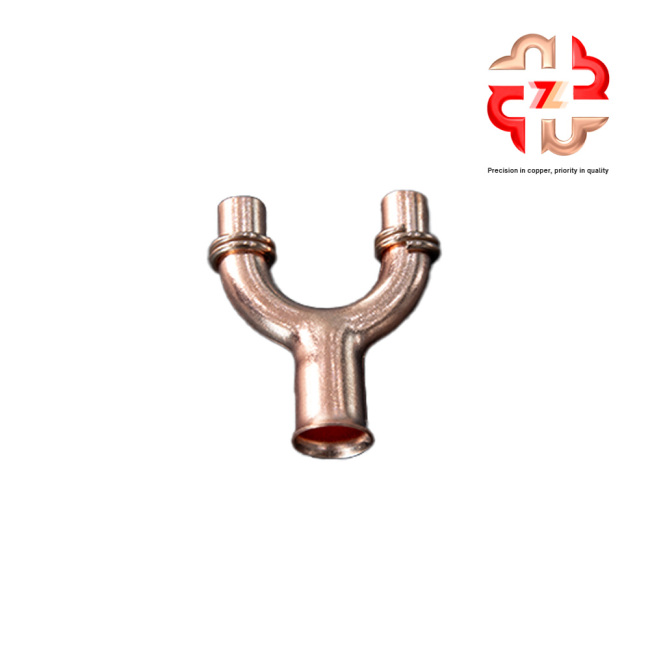
Because the difference is invisible, copper fitting material grade verification mill test certificate discipline is the only defence a buyer has — and an MTR proves nothing unless three things on it match the shipment.
First, the chemistry line. A valid TP2 MTR must show P between 0.015% and 0.040% and O below 0.01%. If the certificate shows "P: remainder" or omits oxygen entirely, it is a generic copper certificate wearing a TP2 label — reject it. Cross-check the UNS number (C12200) or the European designation (Cu-DHP, CW024A); a mill that knows its product prints one of them.
Second, the heat number. The heat number on the MTR must match the heat number stamped or tagged on the actual coil the fittings were made from. A certificate for a different heat is decoration — it happens more often than buyers assume when a press shop buys strip from traders instead of mills. This is the check that makes OEM programmes audit-proof: one photo of the tag next to the MTR per lot, filed with the delivery note.
Third, the mechanical state. The certificate should declare O (annealed) or 1/2H, matching the agreed spec. Grade verification and state verification are separate questions; a TP2 fitting delivered hard when annealed was specified will crack differently — along forming stresses rather than grain boundaries — and the confusion wastes a week of dispute. Together these three checks are the working core of copper fitting material grade verification mill test certificate practice: chemistry, heat match, temper, in that order. Suppliers who hand over all three unprompted — as Zeson does on every heat — are telling you how the melt is controlled upstream.
A spot test worth adding to incoming inspection for critical programmes: bend a sample fitting 90° around a mandrel. TP2 bends cleanly; hydrogen-embrittled or oxygen-bearing copper shows orange-peel cracking on the outer radius within minutes. It costs nothing and catches the one failure mode that no dimension check can see. On custom and Irregular-shaped Tee parts — deep-drawn branches where the metal works hardest — the bend test on a crotch coupon is more informative than the one on the straight body. Xinxiang Zeson Copper Product Co., Ltd. supplies bend coupons on request so the check can run at your dock rather than after assembly.
Buyers sourcing in wholesale volumes should write the grade into the PO as "TP2 / C12200, P 0.015–0.040%, state per drawing" and require MTRs per heat rather than per order. That single line ends the TP1-substitution conversation before it starts, and it gives the factory a written basis for its own incoming strip checks — the cleanest possible answer to a project consultant's certificate questions: one PO line, one document per heat, no interpretation needed.
✅ Bottom line: An MTR that shows the phosphorus range, matches the heat number and states the temper is a certificate; everything else is a pamphlet.
Q: Does the 15% conductivity loss of TP2 ever matter in refrigeration? A: Not in practice. Heat transfer in a fitting happens through metal that is still far more conductive than the brazing alloy and the refrigerant film resistances; the 85% IACS figure matters in busbars and motor windings, which is where T2 belongs. For bulk fitting supply the price gap is under 3% at today's copper spread, which is a small premium for an embrittlement-free braze.
Q: Can I just specify "C12200" and skip the phosphorus range? A: The UNS number already implies 0.015–0.040% P under ASTM B280, so yes — but stating the range explicitly blocks the TP1 substitution, which is the most common way a compliant-looking certificate hides a cheaper melt.
Q: Is hydrogen embrittlement really a risk with modern brazing rods? A: Yes, because the hydrogen comes from the flame, not the filler. Any gas-air or oxy-fuel torch produces a hydrogen-bearing atmosphere; even furnace brazing under forming gas carries it. Only the oxygen-free (phosphorus-deoxidised) base metal removes the reaction partner.
Send Zeson your fitting schedule and required state, and every shipment leaves with heat-matched MTRs showing the phosphorus range, the oxygen figure and the temper — ready to file straight into your incoming-inspection record. Xinxiang Zeson Copper Product Co., Ltd. presses three-way, branch and irregular fittings from TP2 strip sourced mill-direct, with OEM programmes able to lock grade, temper and heat traceability into the PO itself, ODM drawings quoted the same way, and manufacturer-level melt traceability open to audit. Sample bend coupons ship with every first article, and the final TP2 vs T2 copper grade difference for refrigeration fittings check stays with the metal, not the paperwork.
phone:+86 13522609790
Mail:mr.yu@zscoppertech.com
http://zscoppertech.com/

December 26, 2026
Email to this supplier
December 26, 2026
Privacy statement: Your privacy is very important to Us. Our company promises not to disclose your personal information to any external company with out your explicit permission.
Fill in more information so that we can get in touch with you faster
Privacy statement: Your privacy is very important to Us. Our company promises not to disclose your personal information to any external company with out your explicit permission.