


Please Leave Us A Message
Privacy statement: Your privacy is very important to Us. Our company promises not to disclose your personal information to any external company with out your explicit permission.

The scare story says A2L refrigerants run at far higher pressure, so every copper fitting in the plant has to be replaced. Run the numbers and the scare collapses: at a 43 °C condensing condition R32 sits about 4% above R410A and R454B about 3% below it. What actually changes is not the burst margin but the specification sheet — three new fields that most existing drawings never carried. Getting A2L refrigerant R32 R454B fitting pressure compatibility right means reading those fields, not ordering new tees.
Pressure first, because it is the number everyone quotes and the one that moves least.
| Property (43 °C condensing) | R410A | R32 | R454B |
| Safety class (ASHRAE 34) | A1 | A2L | A2L |
| GWP (AR4) | 2,088 | 675 | 466 |
| Saturation pressure, abs | 2.62 MPa | 2.72 MPa | 2.55 MPa |
| At 55 °C | 3.44 MPa | 3.60 MPa | 3.38 MPa |
| Typical system design pressure | 4.15 MPa | 4.30 MPa | 4.15 MPa |
| Relative volumetric capacity | 100% | ~105% | ~96% |
| Discharge temperature vs R410A | baseline | +10 to +15 K | −5 to −8 K |
So the delta at the fitting is +0.10 MPa on R32 and −0.07 MPa on R454B, against a design pressure that already carries a margin of more than 50% over the 55 °C saturation point. A TP2 half-hard tee sized for R410A at 4.15 MPa is not suddenly marginal at 4.30. The exceptions are the two places where margin has already been spent: large-diameter thin-wall parts, and any fitting that was never pressure-rated at all — which is a sourcing problem, not a refrigerant problem. Put differently, A2L refrigerant R32 R454B fitting pressure compatibility is a documentation question before it is a metallurgy question, and the table above is the whole of the metallurgy.
Second number: volumetric capacity. R32 carries roughly 5% more cooling per cubic metre of suction gas than R410A, so the same compressor delivers more capacity and the same circuit runs at slightly higher velocity in a smaller bore. R454B goes the other way, about 4% lower, which means the same tube carries a lower mass flow and lower velocity at part load. That is the quiet risk, and it is the reason do existing copper tees handle R454B operating pressure cannot be answered from a pressure table alone. A circuit that met its oil-return margin on R410A can fall below it on R454B at 50% load, and the symptom — oil logged in a low leg, a compressor that trips on high discharge temperature in spring — appears six months after commissioning, with nothing on the fitting to inspect.
Third number: discharge temperature. R32 runs 10–15 K hotter at the compressor outlet, which is a compressor and oil question far more than a copper question, but it does reach the brazed joint through conduction and thermal cycling. A joint that was marginal on filler penetration will open sooner under a wider cycle. R454B runs cooler, which is the one place it is easier on hardware than R410A.
✅ Bottom line: A2L changes the pressure by single-digit percent; the real work is velocity, oil return and clean, dry internals.
None of this is an argument for a wholesale fitting replacement, and buyers should be sceptical of anyone claiming otherwise. The correct first move is to re-read the existing drawing against the new refrigerant, and the second is to decide which of the three changes actually bites on that circuit. In practice, conversion enquiries arrive as "R32 retrofit, price a new fitting family" and dissolve into one re-rated riser size once the three numbers are put on the table — which is why Zeson answers them with a drawing review rather than a stock list, and why the same logic holds whether the plant builds VRF outdoor units or process chillers.
A copper fitting rated pressure for new refrigerants guide is useful only if it separates "must change" from "keep, with paperwork". Three tiers do that work.
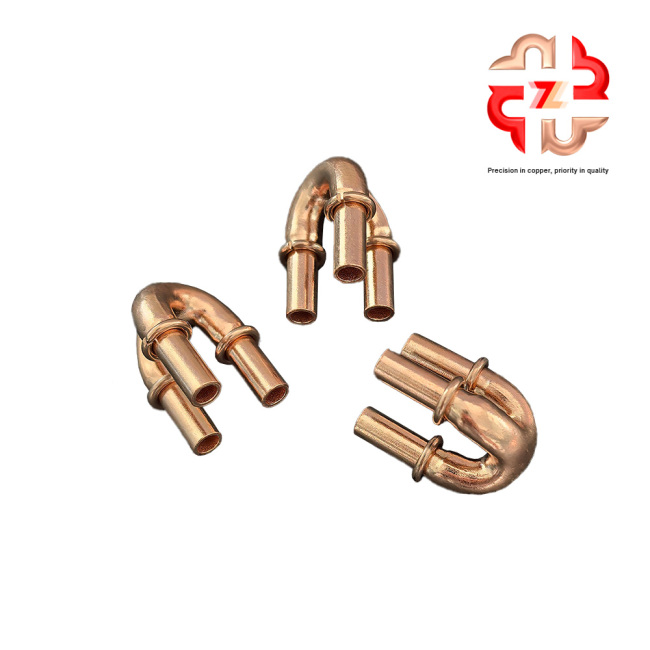
Tier 1 — pass as-is. TP2, half-hard, fully annealed or 1/2H state declared, wall thickness per the size chart, joints hydro-tested to 1.5× design pressure. Nothing in the A2L transition invalidates these parts; the fitting sees 2.7 MPa at worst and was built for 4.15. This covers the large majority of a typical VRF or chiller BOM, including the Three-way Connection bodies and standard Elbow fittings that were specified to a refrigerant fitting standard in the first place. Any copper fitting rated pressure for new refrigerants guide worth reading starts here, because the alternative — replacing compliant parts — is where budgets go to die.
Tier 2 — keep, but change the acceptance test. Anything on the suction side of a system with a charge limit is now a leakage-critical part, because A2L charge restrictions mean a slow leak costs capacity and headroom that the design no longer has spare. Bubble testing at 1 bar no longer qualifies as evidence. The replacement is a quantified leak rate — helium mass-spec on the sub-assembly, or a pressure-decay figure stated in the drawing — plus a dryness specification: POE oil in an A2L system holds moisture far more aggressively than mineral oil did, and a fitting shipped with a damp bore or an open port delivers that moisture straight to the compressor. Sealed ports and a declared moisture limit are now part of the part, not part of the packaging. Zeson ships A2L-bound parts with capped ports and a declared residual moisture figure for this reason, and it is the first question a competent wholesale buyer asks on a bulk order.
Tier 3 — re-rate or replace. Two cases only. First, any part whose wall thickness or temper cannot be documented — if the answer to do existing copper tees handle R454B operating pressure is "we assume so", the part belongs in this tier regardless of refrigerant. Second, deep-drawn branches on large bore where forming thins the crotch by 10–15%: at 4.30 MPa design pressure with a 3/4 inch branch, that thinning is the difference between passing and not, and an Irregular-shaped Tee is the shape where the thinning is worst and the access for measurement is hardest. A supplier who can quote the forming reduction per size moves a part from tier 3 to tier 1 without changing the drawing — and Xinxiang Zeson Copper Product Co., Ltd. publishes that figure per family precisely so the tier decision can be made on paper.
The engineering answer to the headline question, then, is a qualified yes with three conditions attached — documented material and state, quantified leak rate, sealed dry internals. A pneumatic-style bubble test and a verbal assurance will not survive an audit, and neither will a factory that cannot state the forming reduction on a large branch. This is also where research and development earns its place in the conversation: re-rating a family for A2L is a bench exercise — pressure, thermal cycling, helium — not a catalogue swap. Divergence management at the drawing level, choosing which sizes stay and which are re-rated, is cheaper than replacing a whole family to satisfy a fear. For OEM programmes the re-rating note belongs in the drawing package, not in a covering email, because the next engineer to open the file will not read the email.
✅ Bottom line: Most tees pass; the ones that fail do so on documentation and dryness, not on burst margin.
Q: Is R32 really higher pressure than R410A? A: Marginally — about 4% at typical condensing temperatures. Its critical pressure is higher (5.78 vs 4.90 MPa), which matters for subcritical operation near high ambient, but at 43 °C the gap is 2.72 against 2.62 MPa, well inside any correctly rated fitting. That is why the A2L refrigerant R32 R454B fitting pressure compatibility discussion should start with the design pressure on your drawing rather than with the refrigerant name.
Q: Does R454B need a different copper grade? A: No. Both A2L refrigerants are chlorine-free and fully compatible with phosphorus-deoxidised copper and copper-phosphorus brazing filler. What changes is cleanliness and moisture control, because POE oil is hygroscopic and the charge limit removes the margin a slow leak used to hide in.
Q: Can I keep my R410A pressure test procedure? A: Keep the pressure, change the criterion. A 1.5× design hydro test still proves strength, but a pass/fail bubble check no longer proves tightness at the level an A2L charge limit demands — add a quantified decay or helium figure to the drawing.
Send Zeson your existing fitting list and the target refrigerant, and the engineering team returns a tier-by-tier re-rating: which sizes pass unchanged, which need a quantified leak specification, and which large-bore branches need a thicker wall or a different temper. Xinxiang Zeson Copper Product Co., Ltd. presses A2L-ready fittings from TP2 strip with declared state, helium-tested sub-assemblies, sealed dry ports and OEM marking, quoting custom wall thickness for the sizes that genuinely need re-rating rather than the whole family. ODM drawings and wholesale schedules run through the same review, and the manufacturer-level test data behind each size is available before the first order. Sample lots with test data ship inside 7 working days.
phone:+86 13522609790
Mail:mr.yu@zscoppertech.com
http://zscoppertech.com/

December 26, 2026
Email to this supplier
December 26, 2026
Privacy statement: Your privacy is very important to Us. Our company promises not to disclose your personal information to any external company with out your explicit permission.
Fill in more information so that we can get in touch with you faster
Privacy statement: Your privacy is very important to Us. Our company promises not to disclose your personal information to any external company with out your explicit permission.